

Why "Affordable Housing" is nearly impossible to build, even if you run the numbers conservatively.
I get asked a lot, usually by people outside the industry: "Why don't builders just build more affordable homes? Isn't that the solution to the housing crisis?"
So I ran the actual math on a realistic, no-frills, conservative infill project. Sixteen 3-bed, 2-bath, 2-car garage homes, 1,489 square feet each, on 4 acres. Not a premium location. Not luxury finishes. Just a straightforward, modest, "starter home" build, the exact kind of product everyone says we need more of.
Here's what it actually costs to bring one of those homes to market.
The Per-Home Reality
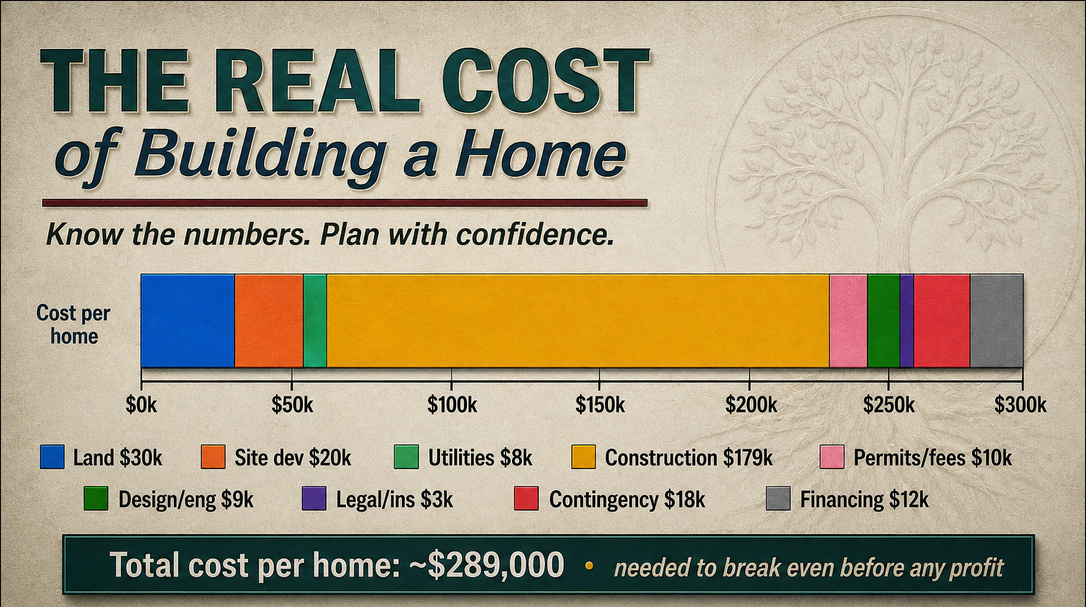
Item Cost Raw land $30,000 Site development (roads, grading, drainage) $20,000 Utility hookups (water, sewer, electric, gas) $8,000 Hard construction (1,489 sqft × $120/sqft) $178,680 Permits & impact fees $10,000 Design/engineering $8,934 Legal, accounting, insurance $3,000 Contingency (7%) $18,103 Construction financing cost $12,300
Total cost, before any profit ~$289,000
That's before I've paid myself a dime. Before the real estate agent gets their 6% commission. Before I've covered the risk of interest rates moving during the 12-18 months it takes to entitle, permit, and build.
Add In the Margin You Actually Need to Survive
Run a builder business at break-even long enough and you go out of business, one bad season, one rate hike, one permitting delay, and you're underwater. So realistically:
Cover cost + commission only: ~$307,600/home
A conservative 15% margin (which is thin for the risk involved): ~$365,000/home
A sustainable 20% margin: ~$395,000/home
That's $4.6M–$6.3M in total revenue needed across 16 homes just to make this project viable, for houses that were never designed to be luxury product in the first place.
Lets not blame just the builders (even though a lot of what is being built is junk)
Nobody in this scenario is being greedy. I didn't pad the land cost, I didn't inflate construction pricing, I didn't build in a premium market. This is about as lean as the math gets. And the "affordable" price point still lands north of $350k–$390k in most markets once financing, permitting, and a sane margin are added in.
The gap between "what it costs to build" and "what a first-time buyer can afford" isn't a builder problem. It's a structural one, made up of:
Land and lot yield constraints, 4 acres only nets 16 usable lots once you account for setbacks, roads, and often a required retention pond.
Permit and impact fees that vary wildly by municipality and are rarely negotiable.
Construction financing costs that get baked into every home regardless of how modest the finishes are.
Risk premium, builders take on 12-18+ months of exposure to rate moves, material cost swings, and labor availability before a single home sells.
So What Actually Moves the Needle?
If we're serious about affordability, the conversation has to shift away from "builders should just charge less" and toward the actual cost levers:
Land cost and lot yield - higher-density zoning, smaller lot minimums, and faster entitlement timelines.
Impact and permit fee reform - these often add $10k-$20k+ per home before a shovel hits the ground.
Construction financing - anything that shortens build timelines or lowers construction loan rates has an outsized effect on final price.
Modular/panelized construction - reducing the $120/sqft hard cost is the single biggest lever available, but it requires buy-in from buyers on a different building method.
Builders aren't the villain in the affordability story. They're running a business with real costs, real risk, and real math, and even the most conservative version of that math doesn't get you to what most people mean by "affordable."
Happy to walk through the model with anyone working on a similar project, land economics like this are very market-specific, and it's worth stress-testing your own numbers before you're 18 months into a build.
What am I missing? If you're a builder, developer, or planner working in this space, I'd genuinely like to hear where your numbers land differently.