


From SFH Flips to Commercial: What Changes, What Doesn't, and What It'll Cost You If You Get It Wrong
The one shift that changes everything
A flip is valued by comps. Commercial is valued by income.
A house is worth what similar houses sold for. A commercial property is worth its NOI (net operating income) divided by the cap rate. That's it, and everything else flows from it.
It's also the good news. If you can raise the income or cut the expenses, you raise the value directly. At a 7% cap rate, every extra $1 of annual NOI adds roughly $14 of value. That's called forced appreciation, and it's why commercial can be so powerful for people who know how to fix buildings.
What stays the same
You make your money when you buy. Bad price, bad deal, and nothing you do later fully fixes it.
Scope, budget, and contractor management. This is where flippers have a real edge.
Sourcing. Off-market outreach, brokers, and referrals still work.
Time is expensive. Carrying costs don't care about your plan.
Local knowledge. Rents, absorption, and neighborhood direction still drive good decisions.
What's different
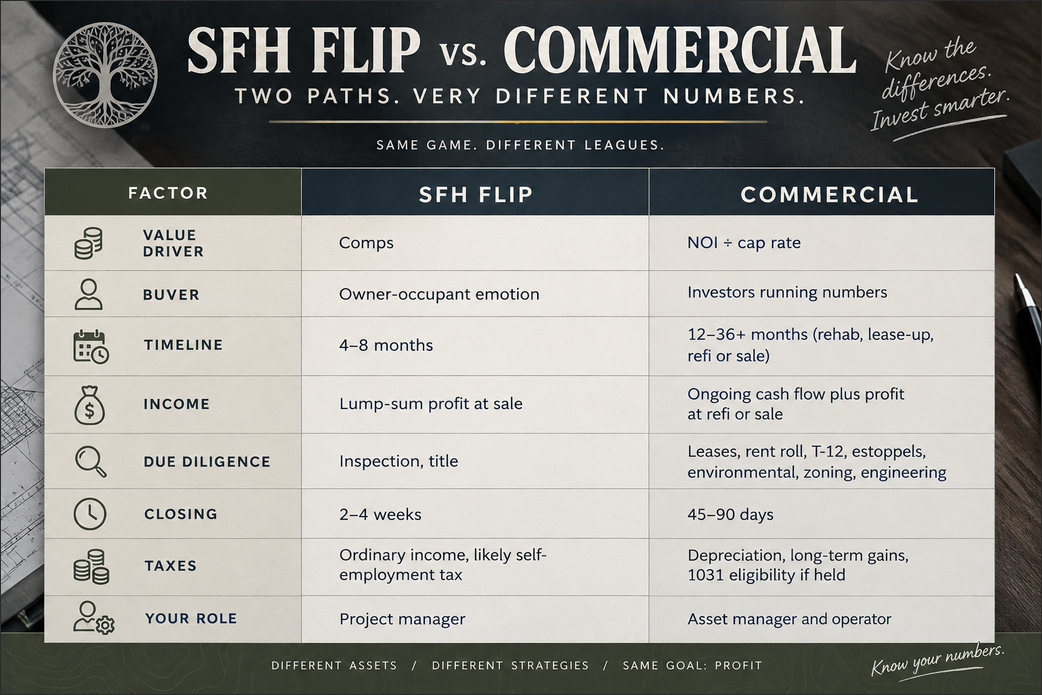
That last row matters most. In a flip you finish the project and leave. In commercial, the building is a business, and you're running it.
Where to start
Pick something that bridges what you already know:
Small multifamily (5-20 units) is the most common first step. Two to four units still qualify for residential loans, and 5+ is commercial financing. The tenants and rehab work feel familiar.
Small mixed-use is good but adds lease complexity.
Small industrial or flex is simple to operate but needs asset-specific knowledge.
Office and retail are the hardest first deals. Tenant credit, lease terms, and rollover risk dominate.
Stay away from specialized assets (hotels, gas stations, medical) until you've done a couple of standard deals.
Learn underwriting before you learn anything else
If you can't run these numbers on a napkin, you're not ready to make an offer:
NOI = effective gross income minus operating expenses (excluding debt service, depreciation, and capital expenses)
Cap rate = NOI ÷ price
DSCR = NOI ÷ annual debt service (lenders typically want 1.20-1.35x)
Debt yield = NOI ÷ loan amount (some lenders want 8-10%+)
Cash-on-cash = annual cash flow after debt ÷ equity invested
Expense ratio: small multifamily commonly runs 35-50% of gross income, depending on who pays utilities
And the rules that keep you out of trouble:
Trust the trailing 12 months, not the seller's pro forma. Verify against bank statements, utility bills, and tax returns.
Underwrite your own expenses. Get a real insurance quote, use realistic property taxes, and include a management fee (5-10% of collections) even if you plan to self-manage, plus replacement reserves.
Use realistic vacancy and credit loss. Nobody collects 100% of 100%.
Stress test it. What if rents come in 10% low, rehab runs 20% over, and rates are 1% higher at refinance? If the deal dies, it was never a deal.
How the loans are different (and why your structure has to change)
This is where most first-timers get hurt, so slow down here.
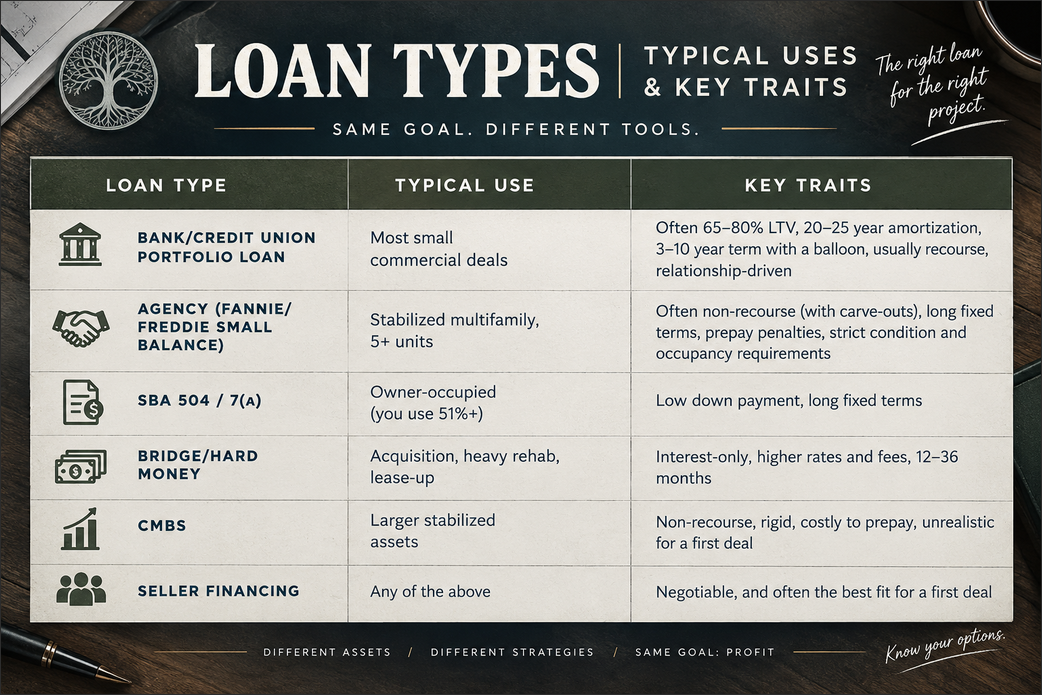
What's different from residential lending:
The property gets underwritten first, you second. DSCR and asset income lead, though most small loans still want a personal guarantee.
Recourse. On most bank loans your personal assets are on the line. Non-recourse loans have "bad boy" carve-outs (fraud, misrepresentation, unauthorized transfers) that can flip you to full liability.
Balloon maturity. A 5-year term on a 25-year amortization means you refinance or sell at year 5, whatever the market is doing.
Prepayment penalties. Step-down (5-4-3-2-1%), yield maintenance, and defeasance can wreck an early sale or refi. Read this section of the term sheet first.
Liquidity and net worth. Lenders often want 6-12 months of debt service in post-closing liquidity and net worth roughly equal to the loan. Confirm with each lender.
Third-party reports. Appraisal, Phase I environmental, property condition assessment, survey, zoning review. Thousands of dollars, and weeks of waiting.
Global cash flow. They look at everything you own and owe, not just this deal.
Occupancy tests. Perm lenders generally want the property stabilized (often 85-90%+ for several consecutive months) before they'll refinance you.
Pricing moves. Rates float off Treasuries or SOFR, so get current quotes from multiple lenders.
How to structure the deal differently
1. Your acquisition loan and your long-term loan are often two different loans. The classic value-add path:
Buy with bridge or seller financing → renovate and lease up → refinance into permanent debt.
2. Size the loan by the tightest constraint, and it's usually DSCR, not LTV. Here's a simplified example with round numbers, not a real deal:
Buy a 10-unit for $700k, put in $100k of rehab, and about $30k in closing and carry. All-in is roughly $830k.
Rents go from $700 to $950 a unit, and stabilized NOI reaches about $65k.
At a 7% cap rate, value is roughly $928k. Looks great.
A 70% LTV loan would be around $650k. But at 7% and a 25-year amortization, debt service is about $55k, and your DSCR is only 1.18x.
To hit 1.25x, the max loan is closer to $613k, which leaves about $217k of your own money still in the deal.
That gap between what you expected to pull out and what the lender will fund is where first-time buyers get burned. Model the refi conservatively from day one.
3. Build time into the contract.
30-60 day due diligence period, with the ability to extend
A financing contingency (don't waive it lightly)
Estoppel certificates and lease assignments as closing conditions
60-90 days to close
4. Plan your reserves. Interest reserve, capital expenditure reserve, and working-capital buffer. A flip is done before reserves matter. A commercial deal isn't.
5. Raising partner money? Call a securities attorney first. Taking other people's money can trigger federal and state securities rules (Reg D and others). Decide on the split structure (preferred return, promote) before you take a dollar.
6. Pick your exit before you buy. Refinance and hold, sell after stabilization, or 1031 into something bigger later. The plan determines the loan. A heavy prepay penalty and a 3-year sale plan don't mix.
Taxes: talk to your CPA before closing, not after
Flipped houses are typically treated as inventory/dealer property: ordinary income, potentially self-employment tax, and no 1031 exchange.
Investment properties can offer depreciation (27.5 years residential, 39 years commercial), possibly accelerated with a cost segregation study, plus long-term capital gains treatment and 1031 eligibility, subject to depreciation recapture.
How you hold the property, and how you intend to hold it, matters.
Your new due diligence checklist
Financial: T-12, rent roll, bank statements, utility bills, tax returns, service contracts
Leases: term, escalations, renewal options, who pays what (NNN vs. gross), rollover schedule, tenant credit
Physical: roof, HVAC, plumbing, electrical, structure, parking, deferred maintenance. Hire a qualified engineer or inspector, and don't rely on the seller's word.
Legal/regulatory: zoning, permitted use, certificate of occupancy, ADA, open code violations
Environmental: Phase I, especially on former gas stations, dry cleaners, and industrial sites
Market: rent comps, vacancy trends, new supply, demand drivers
Insurance and taxes: real insurance quotes, and understand how property taxes may change after the sale
Getting yourself ready
Build a sponsor package: personal financial statement, schedule of real estate owned, 2-3 years of tax returns, credit report, and a resume of your projects with results. Your flip track record is real credibility.
Clean up your finances. Strong credit (often 680-700+), documented liquidity, and low personal debt.
Set up your entities properly with an attorney. Lenders may require special-purpose entity provisions.
Build your team before you need it:
Commercial broker in your asset class
Commercial mortgage broker
Real estate attorney who does commercial deals
CPA who works with investors
Property manager (interview them before you buy)
Insurance broker
Contractor comfortable in occupied buildings
Meet local banks and credit unions now. Portfolio lenders lend to people they know.
Have real capital. Down payments run 20-35%, plus closing costs, reserves, and rehab.
Mistakes I'd help you avoid
Buying on the seller's pro forma instead of verified numbers
Assuming the refinance will return all your equity
Under-reserving for capital expenses and vacancy
Ignoring prepayment penalties and the maturity date
Self-managing without systems, or hiring management too late
Overpaying for a growth story in a compressed cap-rate market
Going big on the first deal instead of small enough to learn
Skipping the attorney and CPA to save a few dollars
The roadmap
Educate yourself. Underwrite 20-30 listings before you make an offer.
Pick one asset type and one market and get good at it.
Build the team and lender relationships.
Assemble your sponsor package and get pre-qualified.
Underwrite conservatively with a written checklist.
Offer with a strong due diligence period.
Close, stabilize, then refinance or sell according to the plan you made before you bought.
Compare results to your underwriting and adjust before the next deal.
Many flippers do one small deal (5-10 units) as a stepping stone and keep flipping to fund reserves. It's a smart way to learn without betting the farm.
Final thought
Commercial isn't harder than flipping. It's different, and the price of not knowing the difference is higher. My goal isn't to hold your hand forever. It's to help you find your own solutions and make better calls on your own. If you want a second set of eyes on a property, a bid, or your numbers before you commit, reach out.
Be blessed, bless others.
Jeph Burnett
This post is for educational purposes only and isn't legal, tax, or financial advice. Lending terms and rates change often, so verify with qualified professionals and current lender quotes.